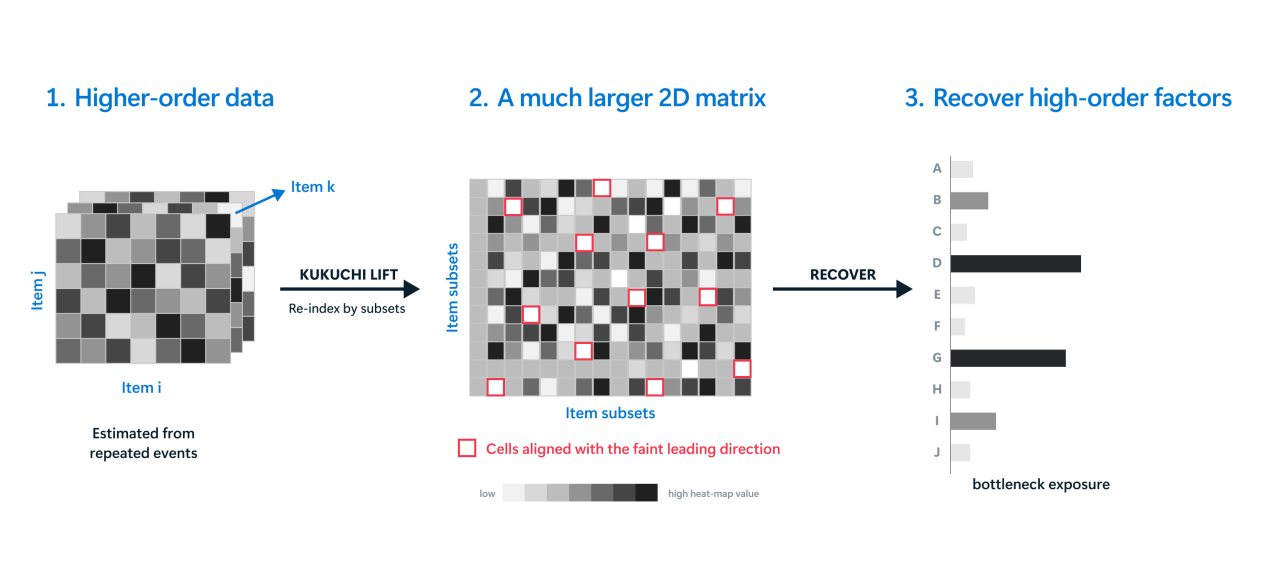
Quantum Tensor PCA can reveal higher-order correlations in complex data.
What QDK for analytics brings to researchers
-
Advanced algorithms for data analysis: Explore quantum approaches that may offer superquadratic speedups over the best-known classical techniques for certain problems.
-
A unified, modular interface: Build on reusable data representations and quantum primitives to move more quickly from real-world problems to executable quantum experiments.
-
Integration with the data science ecosystem: Work with familiar tools for data preparation, model evaluation, and visualization.
-
Classical baselines and reference tools: Compare results with trusted classical implementations and statistical analyses so that findings can be tested, reproduced, and understood.
Exploring real-world financial challenges with LSEG
Powerful algorithms matter only when they are evaluated against meaningful problems. Microsoft and LSEG are collaborating to explore whether advanced analytical methods can uncover complex relationships in financial data and support new insights for financial decision making.
The initial evaluation will assess whether Quantum Tensor PCA can identify patterns and weak signals relevant to financial modeling. Candidate areas include:
-
Mortgage prepayment and credit analytics
-
Market and liquidity risk
-
Counterparty credit risk and valuation adjustments (XVA)
-
Cross-asset tail risk
-
Fixed-income index analytics
-
Environmental, social, and governance (ESG) risk factors
-
Market data feed reliability
LSEG plans to identify priority financial use cases, contribute domain expertise, and evaluate findings within established analytical workflows. Microsoft will provide research tools, technical guidance, and evaluation support. Together, the teams will investigate where higher-order methods such as Quantum Tensor PCA can complement existing approaches and yield meaningful insights into complex financial challenges.
By bringing together emerging quantum analytics research and real-world financial expertise, this collaboration will help produce evidence for where these methods could have practical impact.
Perspectives from LSEG and Microsoft
"Our priority is to understand where new quantum data analytics methods can answer meaningful use cases for our customers. Working with Microsoft gives us an opportunity to test that potential against relevant problems, combining our understanding of financial markets with careful technical evaluation. The focus is on building evidence for where these approaches could add value."
—Sanja Hukovic, Head of Model Risk, LSEG
"The path to useful quantum applications begins with identifying important real-world problems and rigorously evaluating new methods against the strongest approaches available today. LSEG brings deep expertise in financial markets and analytics, helping us focus on the questions that matter most. By working with leaders such as LSEG, we can better understand where quantum data-analysis methods have the potential to create meaningful value and where further research is needed."
—Nathan Baker, Partner, Quantum Applications, Microsoft
Private preview: Bring us your hardest data problems
QDK for analytics is now entering private preview. During this phase, Microsoft will work with invited participants to test the library, improve the developer experience, evaluate priority scenarios, and inform the research roadmap. Feedback from domain experts will be essential to understanding which analytical challenges are best suited to these emerging techniques.
We are looking for collaborators with complex, high-dimensional datasets and rigorous ways to measure success. Whether the challenge comes from financial services, scientific discovery, industrial analytics, or another data-intensive field, the private preview offers an opportunity to test new ideas, compare them with established methods, and help shape the future of QDK for analytics.
Realizing the potential of quantum computing demands more than increasingly powerful machines. It will also require discovering, testing, and refining quantum algorithms for problems where they have the potential to make a meaningful difference. QDK for analytics helps researchers and organizations begin that work today by exploring complex data, investigating hidden patterns and risks, and preparing for a future of quantum-enabled decision making.
Interested in learning more?
Contact us to discuss potential use cases, collaboration opportunities, and gaining access to the QDK for analytics private preview.
References
[1] Hastings, "Accelerating Classical and Quantum Tensor PCA," arXiv:2602.10366.
[2] Chakrabarti, Fontana et al., "End-to-end quantum algorithms for tensor problems," arXiv:2510.07273.