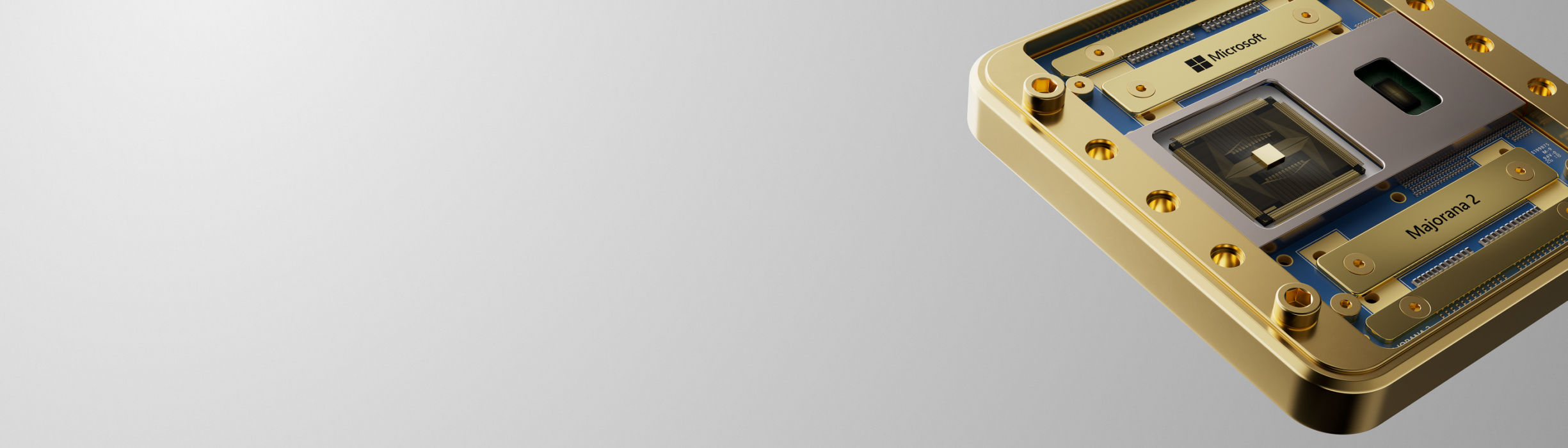
The Majorana 2 quantum processor

Majorana 2

Majorana 2 – Microsoft's Scalable Quantum Processor With Reliable, Long-Lasting Qubits  

By Chetan Nayak, Technical Fellow and Corporate Vice President of Quantum Hardware

Majorana 2 contains qubits that are 1,000x more reliable than those in our previous quantum processing unit. The new material stack, which swaps aluminum for lead, creates highly reliable topological qubits with operations on the microsecond scale and lifetimes with a mean of 20 seconds, occasionally exceeding one minute. This rapid progress, enabled by AI, has cut our timeline in half for delivering a scalable quantum computer—now anticipated by 2029.


Play pause video


To produce the fault-tolerant quantum computers that can realize the promise of quantum technologies, we must design and build scalable quantum processors. Topological qubits are uniquely suited to this task due to their inherently low error rates, small size, and digital control. However, their physics and engineering present subtle challenges. The Microsoft Quantum team has overcome many of these challenges with the assistance of AI. The technical paper on Majorana 2 details how the team designed and fabricated the latest topological quantum processor using a new material stack. 


Topological quantum computing with lead

To create Majorana 2, the Microsoft Quantum team improved Majorana 1’s material stack to create a more stable topological phase. Majorana 2 replaces Majorana 1’s superconductor, aluminum, with lead, and also updates the semiconductor active region to a combination of indium arsenide and indium arsenide antimonide. This change in materials results in significant increases in performance, which are reflected in the improved robustness of the topological phase. The topological gap, which protects the topological qubits from environmental noise and errors, is more than double that of the previous quantum processor.


The gate-defined devices in our quantum processors are composed of tetrons, a type of topological qubit consisting of two superconducting nanowires with Majorana Zero Modes (MZMs) at their ends. MZMs are the building blocks of topological qubits, storing quantum information through parity, the evenness or oddness of the number of electrons in a topoconductor wire. Majorana 2 is a multi-tetron device, the scalable architecture of which is shown in Figure 1. 


A four-qubit array, with each qubit represented by wires in an H-shape.
Figure 1. A four-qubit array, as described in the technical paper, was used to showcase the improvements resulting from our material changes.


Measurement-based control

In topological quantum computing, fundamental operations are carried out through measurements. Measurement-based operations are executed by determining the parity of topoconductor wires. Each parity measurement yields a 0 or a 1, corresponding to an even or odd number or electrons in the topoconductor wire. In our devices, the qubit can thereby be read out in a single shot, allowing us to use measurements to perform calculations. To turn a measurement on or off, we use digital pulses that connect and disconnect quantum dots from nanowires. This type of control and readout, which can also be used to measure the joint parity of two qubits, enables quantum error correction—an essential ingredient for fault-tolerant quantum computing. Computations are broken into sequences of such measurements, together with an additional operation, called a “magic state” preparation.


Enhanced topological qubits

The improved material properties in Majorana 2 translate into enhanced qubit performance. In the aluminum-based Majorana 1, qubit lifetimes were between one and 12 milliseconds, whereas in Majorana 2, the lifetimes exceed 20 seconds, representing more than 1,000x improvement in stability. In some cases, the qubit lifetimes exceeded one minute. This extension of lifespans is due to the larger topological gap made possible by using lead in the material stack (Figure 2).


The Majorana 2 quantum processor and its new material stack, which contains lead, indium arsenide, indium arsenide antimonide, gallium antimonide, barriers, and a buffer.
Figure 2. The new hybrid material stack, designed with AI, consists of lead atop a composite quantum well.


Advancing through DARPA's Quantum Benchmarking Initiative

The Defense Advanced Research Projects Agency (DARPA) previously advanced Microsoft as one of only two companies to the final phase of their rigorous program to evaluate quantum systems. The Microsoft Quantum team continues to make progress in DARPA’s Underexplored Systems for Utility-Scale Quantum Computing (US2QC), one of the programs that makes up their larger Quantum Benchmarking Initiative (QBI). 


DARPA’s US2QC program and its broader QBI represent a rigorous approach to evaluating quantum systems that could solve problems that are beyond the capabilities of classical computers. To date, the US2QC program has brought together experts from organizations including DARPA, Air Force Research Laboratory, Johns Hopkins University Applied Physics Laboratory, Los Alamos National Laboratory, Oak Ridge National Laboratory, Lawrence Berkeley National Laboratory, and Lawrence Livermore National Laboratory to verify quantum hardware, software, and applications. Going forward, the QBI is expected to engage with even more experts in the testing and evaluation of quantum computers.


Previously, DARPA selected Microsoft for an earlier phase upon an assessment that we could plausibly build a utility-scale quantum computer in a reasonable timeframe. DARPA then evaluated the Microsoft Quantum team’s architectural designs and engineering plan for a fault-tolerant quantum computer. As a result of this careful analysis, DARPA and Microsoft executed an agreement to begin the final phase of the program. During this phase, Microsoft intends to build a fault-tolerant prototype based on topological qubits in years, not decades—a crucial acceleration step toward utility-scale quantum computing. 


Our accelerated roadmap to a scalable quantum machine

By overcoming formidable obstacles in physics, Majorana 1 was realized. Over the year that followed, the Microsoft Quantum team met the engineering challenges of manufacturing topological qubits with Majorana 2. Based on this rapid progress, we are accelerating our roadmap to a scalable, practical quantum computer—we have cut our timeline in half and now aim to reach this target by 2029. This achievement will mark a major milestone on the path to a transformative fault-tolerant quantum computer that has the potential to solve problems that affect all of humanity. 


Learn more about the latest advances from Microsoft Quantum