Azure Quantum compute platform
To enable reliable quantum computing, Microsoft has developed the Azure Quantum compute platform. This compute platform combines Microsoft’s advanced qubit-virtualization system with quantum-processing units (QPUs) from our industry-leading hardware partners to create logical qubits by detecting and correcting the errors inherent in the QPU’s physical qubits, in turn enabling reliable quantum computation.
Microsoft’s qubit-virtualization system is a core component of the Azure Quantum compute platform and builds on Microsoft’s world-class quantum error correction innovations. It offers high performance quantum error correction, custom-tailored for the underlying QPU and can be applied to a variety of QPU types. By co-designing the quantum computer with Atom Computing, we are enabling faster, more advanced, and more efficient quantum error correction as part of our qubit-virtualization system.
Creating and entangling logical qubits
To enable complex quantum computations, qubits must meet several criteria. The physical qubits must have low enough error rates to enable error detection and correction so that they can be used to create reliable logical qubits. Those logical qubits must then be able to not only be entangled, but also to undergo many logical operations without failure to enable successful solutions to complex computations.
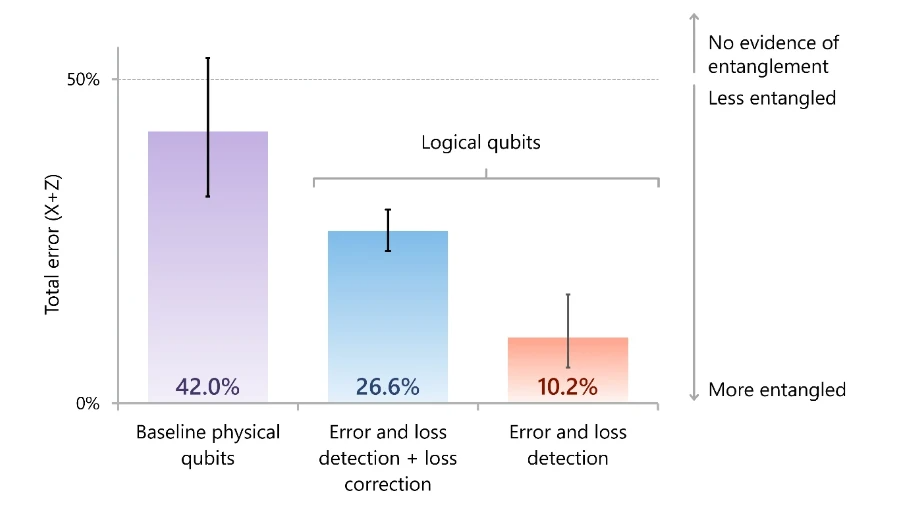
By applying Microsoft’s qubit-virtualization system to Atom Computing’s neutral-atom qubits, the teams created 24 logical qubits and entangled them in a cat state, or Greenberger-Horne-Zeilinger (GHZ) state—this represents the highest number of entangled logical qubits on record. Entanglement of the qubits is evidenced by their error rates being significantly below the 50% threshold for entanglement (Figure 1).
When using neutral atoms as qubits and attempting to hold them in place with lasers, some atoms can still become lost, resulting in a loss of that qubit and its quantum information. Thus, the teams took steps to not only detect errors but also to detect and correct losses of neutral-atom qubits during experiments. After creating logical qubits from neutral atoms and detecting errors and losses, the error rate in the logical qubits was 10.2%, which is 4.1 times better than the baseline physical error rate of 42% (Figure 1). When errors were detected and losses were detected and corrected, the error rate was 26.6%, which is 1.6 times better than the physical error rate (Figure 1). This is the first demonstration on record of loss correction in a commercial neutral-atom system.
Twenty-eight logical qubits, created from 112 physical qubits, were used to perform successful computations based on the Bernstein-Vazirani algorithm. Furthermore, the logical qubits were able to produce a more accurate solution than the corresponding computation based on physical qubits. The ability to compute while detecting and correcting errors is a critical component to scaling to achieve scientific quantum advantage.