A purpose-built computing platform for science
Many of the hardest problems facing society, such as reversing climate change, addressing food insecurity and solving the energy crisis, are chemistry and materials science problems. However, the number of possible stable molecules and materials may surpass the number of atoms in the observable universe. Even a billion years of classical computing would be insufficient to explore and evaluate them all.
That’s why the promise of quantum is so appealing. Scaled quantum computers would offer the ability to simulate the interactions of molecules and atoms at the quantum level beyond the reach of classical computers, unlocking solutions that can be a catalyst for positive change in our world. But quantum computing is just one layer for driving these breakthrough insights.
Whether it’s to supercharge pharma productivity or pioneer the next sustainable battery, accelerating scientific discovery requires a purpose-built, hybrid compute platform. Researchers need access to the right tool at the right stage of their discovery pipeline to efficiently solve every layer of their scientific problem and drive insights into where they matter most. This is what we built with Azure Quantum Elements, empowering organizations to transform research and development with capabilities including screening massive data sets with AI, narrowing down options with high-performance computing (HPC) or improving model accuracy with the power of scaled quantum computing in the future.
We continue to advance the state-of-the-art across all these hybrid technologies for our customers, with today’s quantum milestone laying the foundation for useful, reliable and scalable simulations of quantum mechanics.
Moving toward resilience
In an article I wrote on LinkedIn, I used a ‘leaky boat’ analogy to explain why fidelity and error correction are so important to quantum computing. In short, fidelity is the value we use to measure how reliably a quantum computer can produce a meaningful result. Only with good fidelity will we have a solid foundation to reliably scale a quantum machine that can solve practical, real-world problems.
For years, one approach used to fix this leaky boat has been to increase the number of noisy physical qubits together with techniques to compensate for that noise but falling short of real logical qubits with superior error correction rates. The main shortcoming of most of today’s NISQ machines is that the physical qubits are too noisy and error-prone to make robust quantum error correction possible. Our industry’s foundational components are not good enough for quantum error correction to work, and it’s why even larger NISQ systems are not practical for real-world applications.
The task at hand for the entire quantum ecosystem is to increase the fidelity of qubits and enable fault-tolerant quantum computing so that we can use a quantum machine to unlock solutions to previously intractable problems. In short, we need to transition to reliable logical qubits — created by combining multiple physical qubits together into logical ones to protect against noise and sustain a long (i.e., resilient) computation. We can only obtain this with careful hardware and software co-design. By having high-quality hardware components and breakthrough error-handling capabilities designed for that machine, we can get better results than any individual component could give us. Today, we’ve done just that.
“Breakthroughs in quantum error correction and fault tolerance are important for realizing the long-term value of quantum computing for scientific discovery and energy security. Results like these enable continued development of quantum computing systems for research and development.”
- Dr. Travis Humble, Director, Quantum Science Center, Oak Ridge National Laboratory
A breakthrough for handling quantum errors
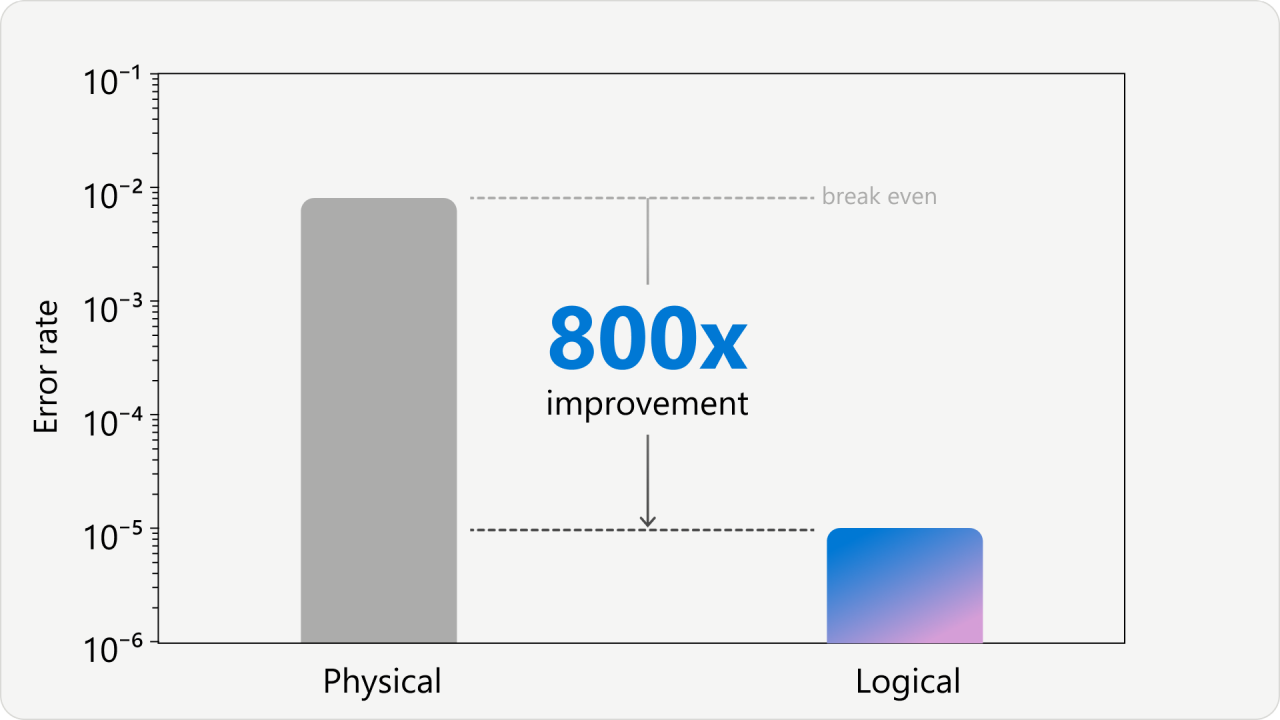
That’s why today is such a historic moment: for the first time on record as an industry, we’re advancing from Level 1 Foundational to Level 2 Resilient quantum computing. We’re now entering the next phase for solving meaningful problems with reliable quantum computers. Our qubit-virtualization system, which filters and corrects errors, combined with Quantinuum’s hardware demonstrates the largest gap between physical and logical error rates reported to date. This is the first demonstrated system with four logical qubits that improves the logical over the physical error rate by such a large order of magnitude.