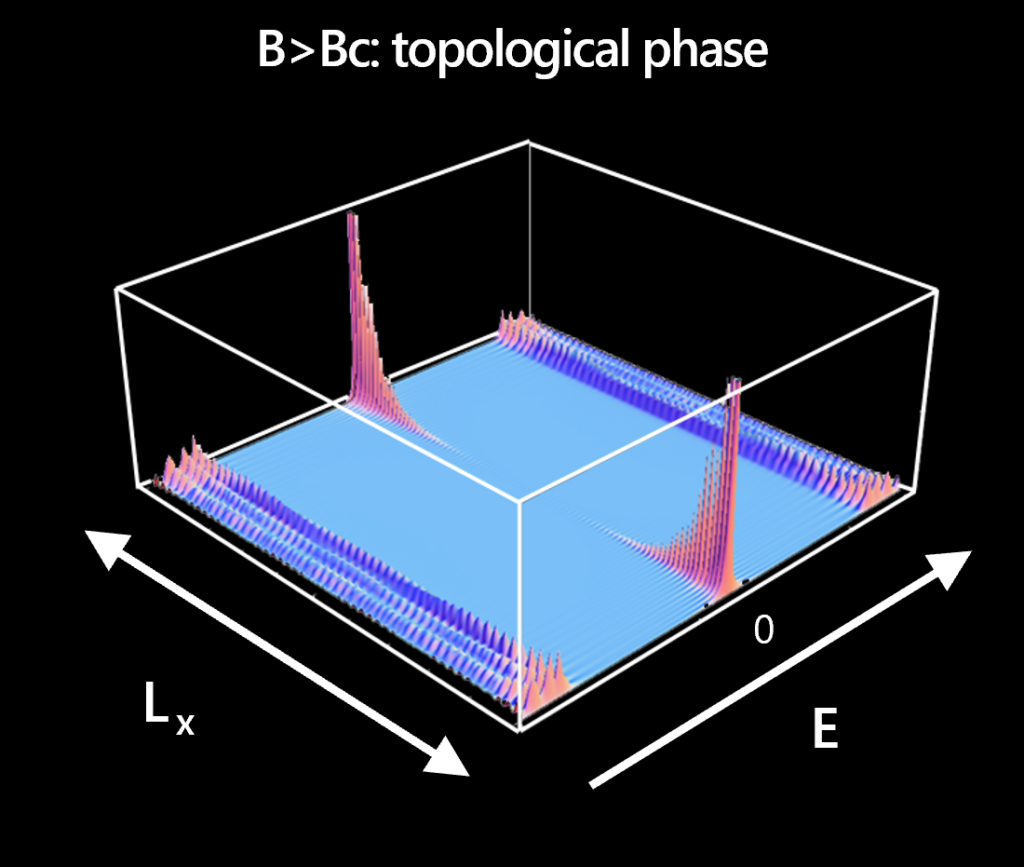
Figure 1: The local density of states of a topological superconducting nanowire as a function of energy and position.
We have simulated our devices using models that incorporate the details of the materials stack, geometry, and imperfections. Our simulations have demonstrated that the TGP is a very stringent criterion, rendering it a reliable method for detecting the topological phase in a device. Crucially, the conditions for passing the protocol—the presence of stable ZBPs at both ends of the device over a gapped region with gapless boundary, as established via the non-local conductance—were established before any devices had been measured. Given the subtleties involved in identifying a topological phase, which stem from the absence of a local order parameter, one of the design principles of the TGP was to avoid confirmation bias. In particular, the device is scanned over its entire operating range instead of ‘hunting’ for a specific desired feature, such as a ZBP.
Microsoft’s Station Q, in Santa Barbara, CA, is the birthplace of Microsoft’s quantum program. For the last 16 years, it has been the host of a biannual conference on topological phases and quantum computing. After a two-year hiatus of in-person meetings due to the pandemic, the Station Q meetings resumed in early March. At this meeting with leaders in quantum computing from across industry and academia, we reported that we have multiple devices that have passed the TGP.
Our team has measured topological gaps exceeding 30 μeV. This is more than triple the noise level in the experiment and larger than the temperature by a similar factor. This shows that it is a robust feature. This is both a landmark scientific advance and a crucial step on the journey to topological quantum computation, which relies on the fusion and braiding of anyons (the two primitive operations on topological quasiparticles). The topological gap controls the fault-tolerance that the underlying state of matter affords to these operations. More complex devices enabling these operations require multiple topological wire segments and rely on TGP as part of their initialization procedure. Our success was predicated on very close collaboration between our simulation, growth, fabrication, measurement, and data analysis teams. Every device design was simulated in order to optimize it over 23 different parameters prior to fabrication. This enabled us to determine the device tuning procedure during design.
Our results are backed by exhaustive measurements and rigorous data validation procedures. We obtained the large-scale phase diagram of multiple devices, derived from a combination of local and non-local conductances. Our analysis procedure was validated on simulated data in which we attempted to fool the TGP. This enabled us to rule out various null hypotheses with high confidence. Moreover, data analysis was led by a different team than the one who took the data, as part of our checks and balances between different groups within the team. Additionally, an expert council of independent consultants is vetting our results, and the response to date is overwhelmingly positive.
With the underlying physics demonstrated, the next step is a topological qubit. We hypothesize that the topological qubit will have a favorable combination of speed, size, and stability compared to other qubits. We believe ultimately it will power a fully scalable quantum machine in the future, which will in turn enable us to realize the full promise of quantum to solve the most complex and pressing challenges our society faces.