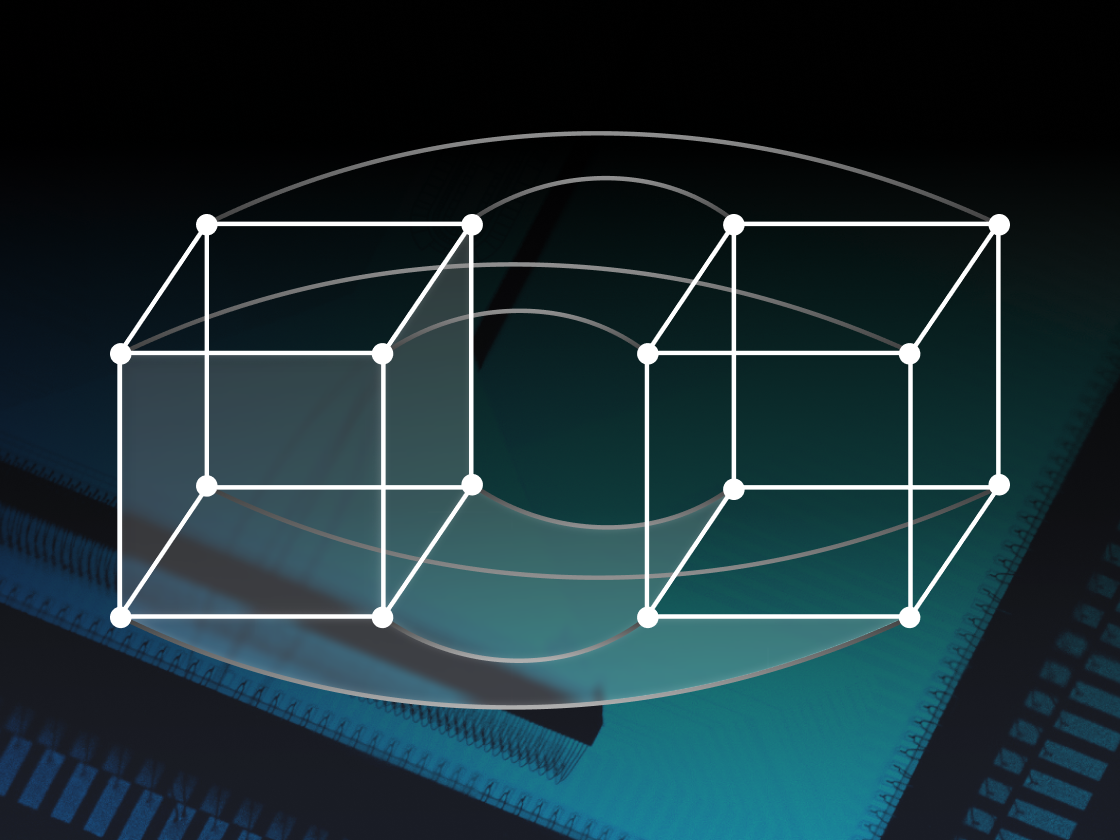
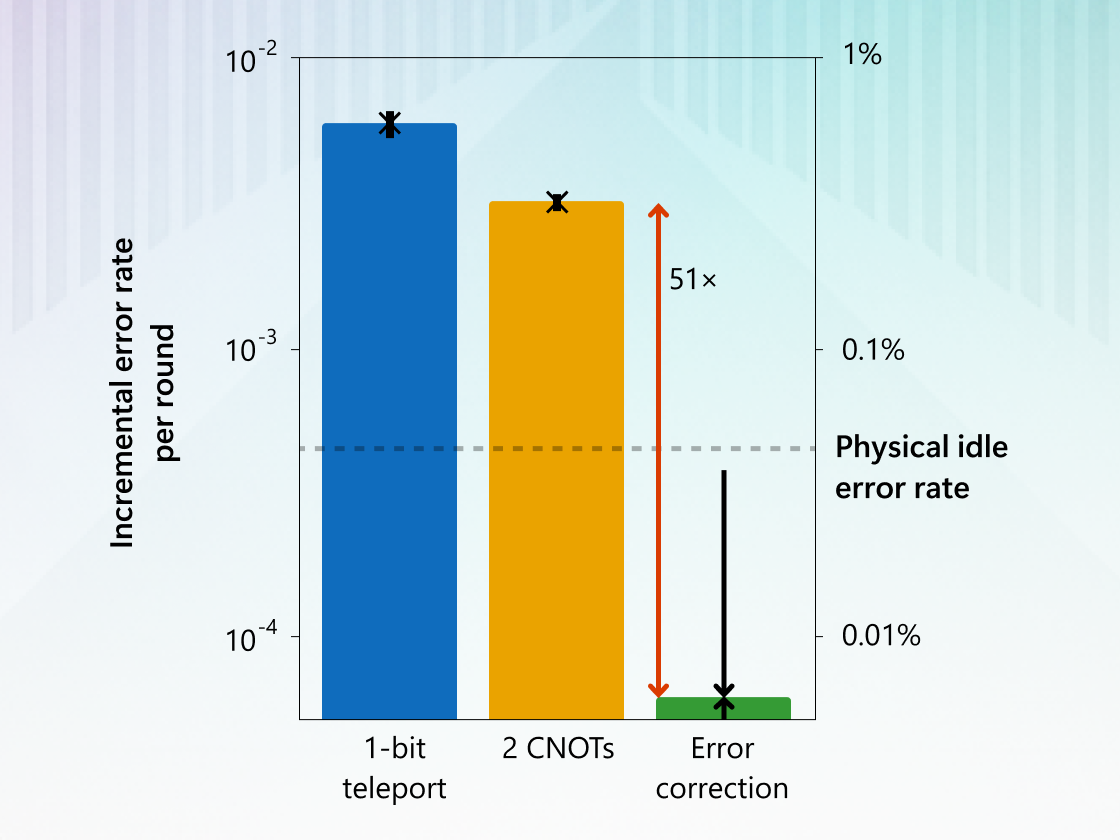
Figure 2. The carbon code in action. Logical error rate (green bar) grows far more slowly with rounds of error correction than the physical 1-bit-teleport (blue bar) and 2-CNOT (orange bar) baselines. .
From research to product: the QEC stack for Magne
The Nature experiments were hand-built. Every code choice and every syndrome circuit were tailored to the experimental setup. Turning the same capability into a platform is a different kind of engineering, and it is the work now in flight. Encoding, synthesis, and real-time decoding are becoming distinct, testable, performance-budgeted modules in Microsoft's quantum software stack, with defined interfaces and measurable error budgets. The objective has shifted from setting individual records to making reliable logical qubits available to users on demand.
That platform finds its first commercial home in Magne—the Level 2 Resilient quantum computer being co-designed and built by Microsoft and Atom Computing and operated by QuNorth in Copenhagen—a joint initiative of the Export and Investment Fund of Denmark (EIFO) and the Novo Nordisk Foundation. Magne pairs Atom Computing's neutral-atom hardware—more than 1,200 physical qubits—with Microsoft's full quantum software stack, and is expected to come online early in 2027.
“Quantum Error Correction (QEC) is a definite prerequisite to achieving meaningful quantum advantage with broad application across domains. With Magne, users will finally start to reap the rewards of seamless QEC in the form of more reliable computation, without having to worry about the mechanics of QEC. All they need is to bring their logical circuits.”
—Dr. Kasra Nowrouzi, CTO of QuNorth
In practical terms, Magne will be one of the first systems to enable quantum error correction so that users who want to benefit from logical qubits can do so without the need to implement their own encoding and decoding. Delivering that experience is less about adding more physical qubits than building an end-to-end software stack—synthesis, encoding, decoding, control, compilation, and scheduling—that holds together while more than 1,200 physical qubits do their work.
Microsoft's progress on fault tolerance extends beyond Magne. Our quantum error-correction team continues to design new code families, more efficient decoding strategies, and the system architectures needed to make those innovations practical at the scale a useful algorithm demands. This is all done with the mission of deploying these software innovations on a Majorana-based quantum machine in the near future.
QDK for error correction: deq and an open toolchain for the community
The toolchain that Microsoft Quantum's error-correction researchers use to develop, test, and deploy new error-correction techniques is being open-sourced in the QDK for error correction. These are the same packages that are being incorporated into Magne, and they are being made available to the wider community both for use on Magne and for error-correction research more broadly, to help accelerate the path to fault-tolerant quantum computing.
The QDK for error correction is a family of focused, composable packages. Those already available include high-performance Rust crates and Python packages for binary linear algebra (binar), Pauli and Clifford algebra (paulimer), and fast stabilizer simulation (pauliverse)—the building blocks needed to design, validate, and benchmark a custom code or fault-tolerant gadget before it touches hardware.
The newest open-sourced addition is deq—the first decoding system that makes fault-tolerant computation truly composable. On the physical side, composability is free: A sequence of logical gates is simply the physical gates running back-to-back. Decoding is the opposite. Each logical gate's decoding problem depends on the surrounding circuit, not the gate in isolation, and stitching those problems together across a real computation has, until now, required a human expert to hand label every piece. deq automates that stitching end-to-end, delivering a feature that all scalable proposals assume but none have realized.
deq also features a modular design that lets the core decoding algorithm be chosen and revisited as an engineering decision. The same deq that targets Magne's classical control plane can be re-targeted to a surface-code experiment in a university lab or used offline to benchmark a custom code under design. Modularity matters here because decoding is the layer at which physics, code distance, classical-compute budget, and end-application accuracy interact; the best decoder for a given workload depends on all four.
Microsoft’s QDK offers capabilities that extend beyond error correction. Its quantum resource estimator allows researchers to test the functionality of quantum algorithms and accurately estimate the quantum resources that would be required to run them. The QDK for error correction, deq, and the rest of the currently available toolchain are on GitHub under an MIT license. Expect continued releases of new open-source QDK for error correction packages as the toolchain grows.
“Magne will also enable QEC researchers to develop, test, and deploy novel QEC codes. The combination of Microsoft’s QEC tools with openness and modularity, and Atom Computing’s all-to-all connectivity at the scale of 1200+ physical qubits, enables Magne to be an excellent platform to advance QEC, paving the way to future Level 3 fault-tolerant quantum computers.”
—Dr. Kasra Nowrouzi, CTO of QuNorth
If you build quantum software—algorithms, codes, decoders, or the classical control plane—we welcome your participation. Clone the QDK for error correction, try deq, and tell us what you think.
Learn more about Microsoft’s research in quantum error correction