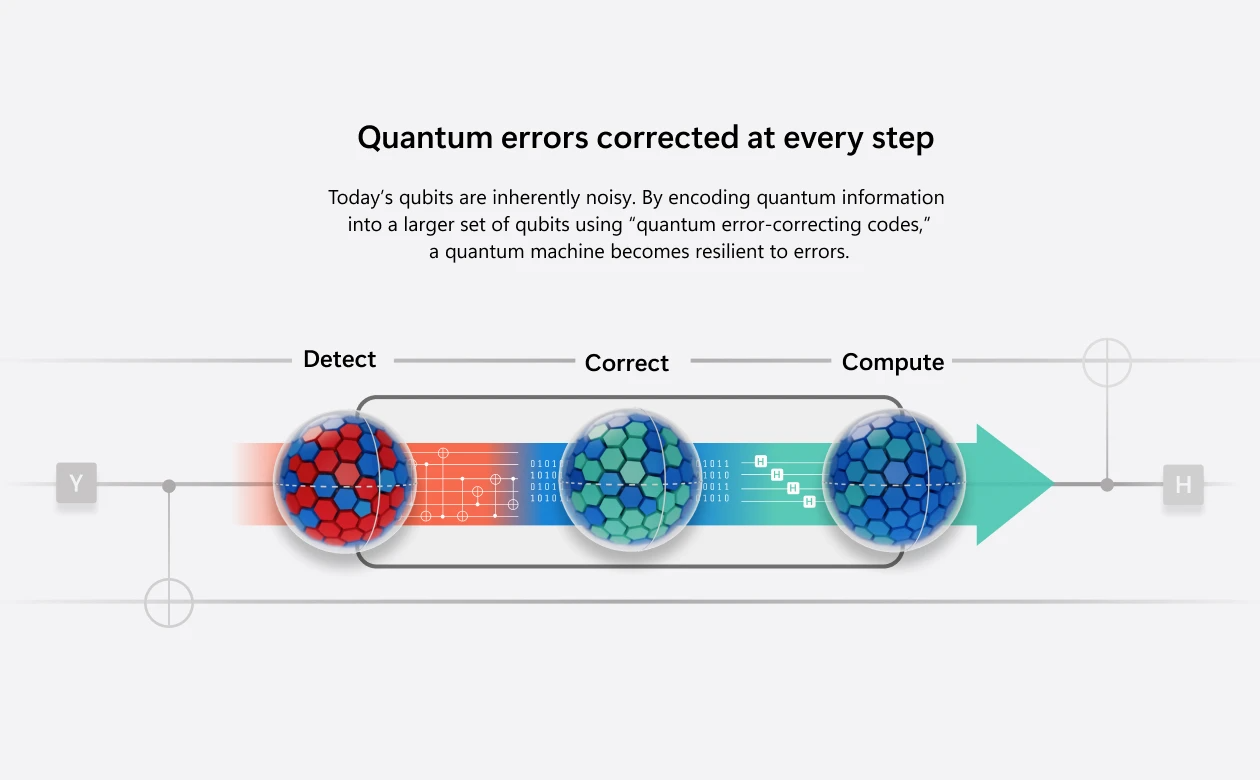
By detecting and correcting errors during computation, the Microsoft Quantum compute platform creates logical qubits from high-quality physical qubits to enable reliable quantum computation.
Microsoft’s new four-dimensional (4D) geometric codes
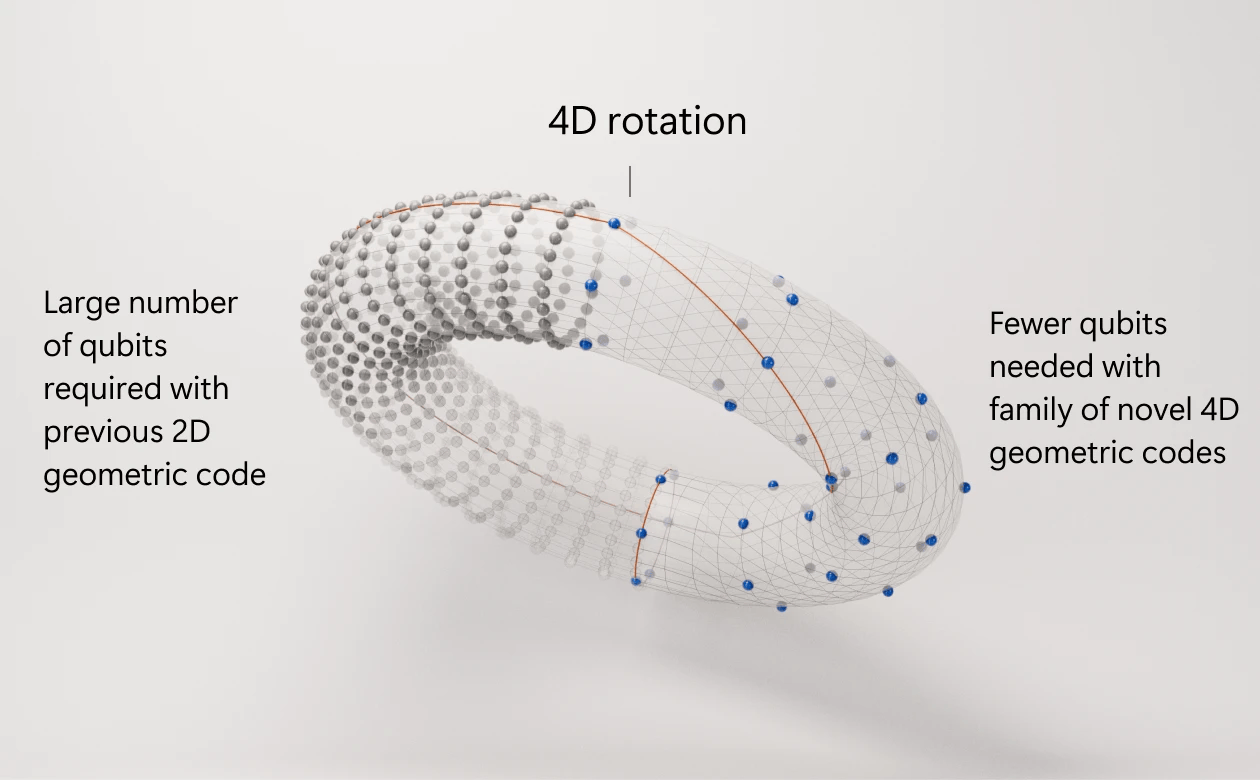
Even high-quality physical qubits require error correction to create and entangle the logical qubits that enable reliable quantum computation. To that end, Microsoft has developed a family of novel 4D geometric codes, which are available in the Microsoft Quantum compute platform and are suitable for qubits with all-to-all connectivity such as neutral atoms, ion traps, and photonics. These powerful codes can reduce the error rates of physical qubits by orders of magnitude to reach the level required for quantum circuits to operate reliably.
Microsoft’s new 4D geometric codes:
- Require very few physical qubits to make each logical qubit: Rotating the codes in four dimensions achieves a fivefold reduction in the number of physical qubits required to make logical qubits.
- Have efficient logical operations: The codes exhibit high performance and have the single-shot property that enables them to correct errors quickly.
- Improve the performance of quantum hardware: A 1,000-fold reduction in error rate can be achieved by lowering the physical error rate from 10-3 (one per thousand) to a logical error rate of approximately 10-6 (one per million).
With these features, this family of novel codes provides several benefits. The codes reduce the number of steps required to diagnose errors, resulting in low-depth operations and computations. Additionally, these codes reduce the number of physical qubits needed to achieve fault-tolerant quantum computing, accelerating the path to utility scale.
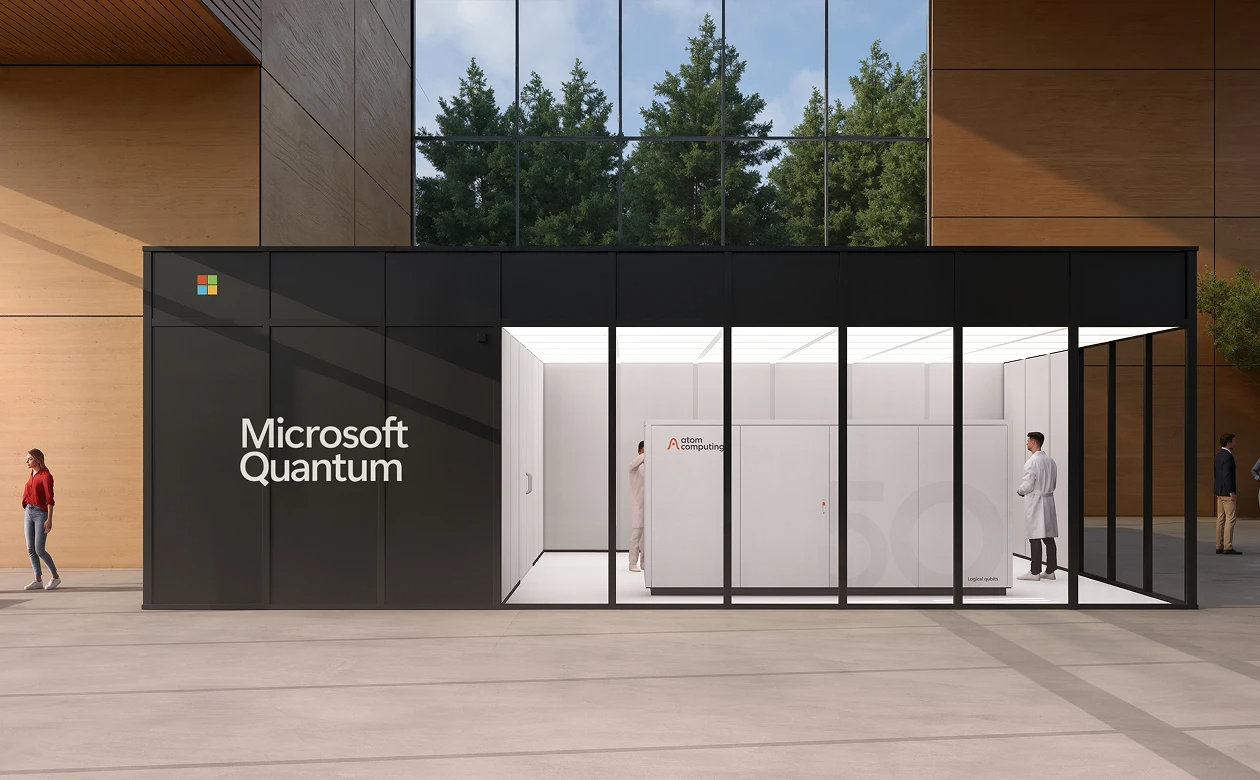
This family of codes is one of many that is available for inclusion in the Microsoft Quantum compute platform. It comes with a complete set of efficient operations that makes compilation of any quantum algorithm possible. Incorporation of these codes into our full-stack will enable the creation and entanglement of 50 logical qubits in the near term, with the potential to scale to thousands of logical qubits in the future.
The Microsoft Quantum advantage
At Microsoft, we are bringing the capabilities for quantum advantage forward by coupling state-of-the-art quantum hardware with the Microsoft Quantum compute platform, which includes error correction, cloud high-performance computing, and advanced AI models. And now, these capabilities can be paired with Microsoft Discovery—our platform designed to accelerate scientific progress.
In addition to the strength of the co-optimized hardware and software, Microsoft’s team of experts is available to provide insight and technical expertise on use cases, industry challenges, and opportunities for innovation and collaborative research projects. This allows customers to explore quantum applications, generate new datasets with reliable quantum computing, improve the performance or accuracy of AI models, and provide regional skilling and education in quantum computing.
Microsoft and Atom Computing
Together, Microsoft and Atom Computing have co-designed a pairing of neutral-atom qubits with the Microsoft Quantum compute platform. Atom Computing’s neutral-atom qubits have several advantages over some other qubit technologies, including their ability to be tightly packed in arrays due to their lack of charge, which offers extensive scalability. Additionally, they can be moved around to allow interactions with other atoms, they have low susceptibility to noise, and they have the high fidelities needed for quantum error correction to work.
Since our last announcement on our collaboration with Atom Computing, the company has demonstrated improved mid-circuit measurement with qubit reset and reuse on their hardware. This technique—which allows for the measurement of a subset of qubits while preserving both measured and unmeasured qubits—improves error correction, increases the complexity of quantum computations that can be performed, and paves the way for fault-tolerant quantum computing. Additionally, the two-qubit gate fidelity of Atom Computing’s neutral atoms is 99.6%, which remains the highest fidelity of neutral-atom qubits in a commercial system.
The high fidelities, all-to-all connectivity, and long coherence times available with Atom Computing’s neutral-atom qubits make them well suited for the creation of logical qubits with the Microsoft Quantum compute platform.