At Microsoft, we’re ushering in a new era of computing on the path to unlocking scientific advantage and tackling some of the world’s most pressing challenges. This is why we’re building Azure Quantum—to create the first platform for reliable quantum computing and achieve the vision of quantum at scale.
In April, we announced we’re entering the next phase for solving meaningful problems with reliable quantum computers by demonstrating the most reliable logical qubits with an error rate 800x better than physical qubits. The main issue with today’s noisy intermediate-scale quantum (NISQ) machines is that their physical qubits are too noisy and error-prone, making the machines impractical for real-world applications. That’s why we must transition to using reliable logical qubits that combine multiple physical qubits together to protect against noise and to maintain coherence for long-running computations.
But quantum computing doesn’t exist in isolation. It requires deep integration with the power of the cloud. We must leverage the best of computing to unlock a new generation of hybrid quantum applications that could solve some of our most pressing challenges—from pioneering more sustainable energy solutions to transforming how we treat disease with the next generation of life-saving therapeutics.
We designed the Azure Quantum compute platform to provide quantum computing across a variety of hardware architectures, enabling the most advanced hybrid quantum applications in the industry—all in a secure, unified and scalable cloud environment—to tackle classically intractable problems. This is our vision for Azure Quantum. Today, we continue to make advances that bring us closer to achieving it with our industry-leading partners, Quantinuum and Atom Computing. With both companies, we want to bring best-in-class solutions to the Azure Quantum platform, and collectively advance and scale resilient quantum capabilities.
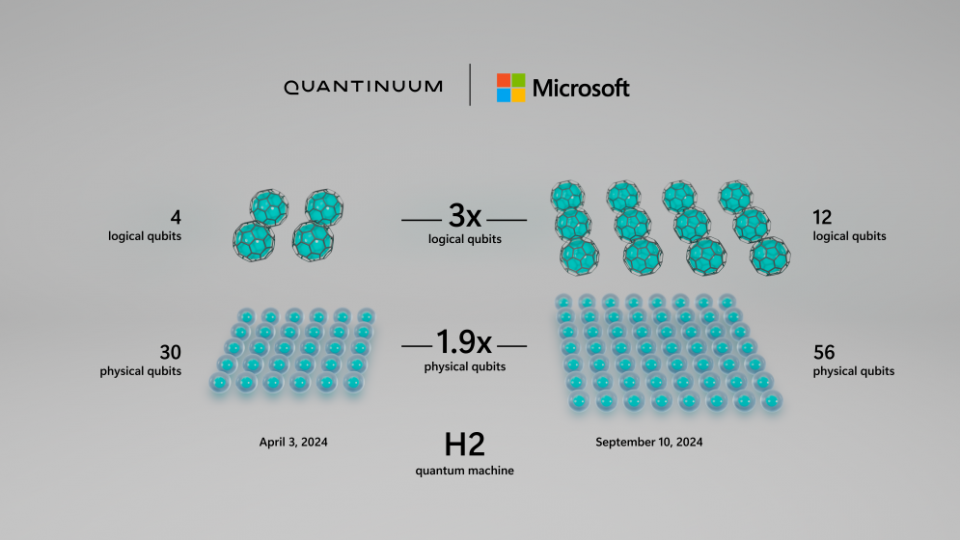
In collaboration with Quantinuum, we applied our improved qubit-virtualization system to create and entangle 12 highly reliable logical qubits. This represents the largest number of entangled logical qubits, with the highest fidelity, on record. These results scale logical qubit computation—on ion-trap hardware—within our Azure Quantum compute platform. In addition, advancing toward scalable quantum computing necessitates not only reaching significant hardware milestones, but also proving these improvements can address practical and real-world challenges.
This is why we demonstrated the first end-to-end chemistry simulation that combines reliable logical quantum computation with cloud high-performance computing (HPC) and AI. Today’s announcements would not have been possible without Quantinuum’s leading quantum machines. This paves the way toward practical solutions at the intersection of these technologies, especially in the domains of chemistry, physics and life sciences.
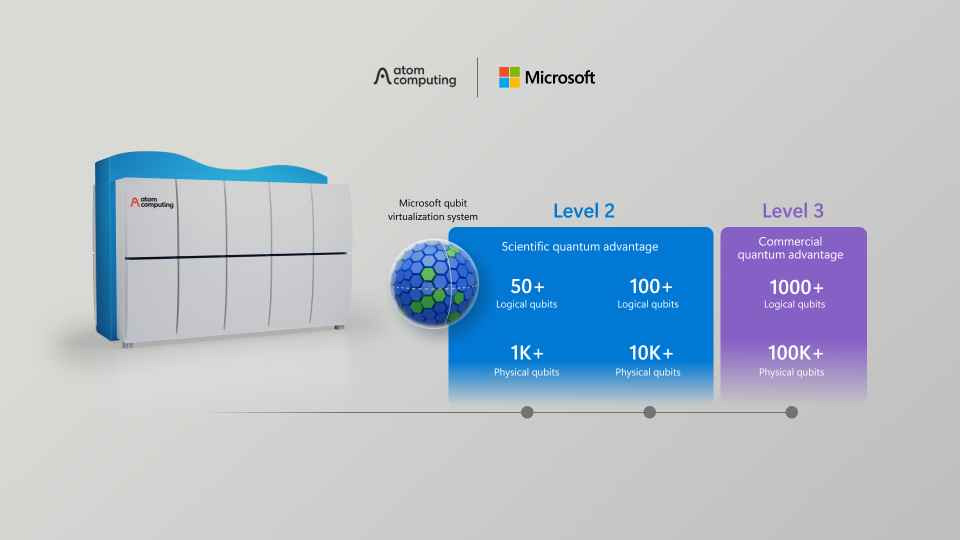
Lastly, as we expand our Azure Quantum compute platform, we are excited to announce that Microsoft and Atom Computing are coming together to ultimately build the world’s most powerful quantum machine. Through this collaboration, we’re bringing a new generation of reliable quantum hardware to customers by integrating and advancing Atom Computing’s neutral-atom hardware into our Azure Quantum compute platform. With it, we are bringing the best-in-class from Microsoft and our partner ecosystem to provide the commercial offering of a reliable quantum machine.
Combining the capabilities of this reliable quantum hardware with our platform for Science, Azure Elements, we are providing a comprehensive discovery suite to achieve scientific quantum advantage.
Creating a new generation of hybrid quantum applications
At Microsoft, we’re pioneering a new computing paradigm by bringing the power of the cloud and AI together with quantum. Our Azure Quantum compute platform enables the seamless execution of quantum applications that leverage hardware across a variety of qubit architectures and chips, while offering integration with cloud HPC and AI. Over this past year, we’ve continued to announce new breakthroughs and collaborations in pursuit of this platform mission, including offering Generative Chemistry and Accelerated DFT and advancing the industry to reliable quantum computing by demonstrating highly reliable logical qubits.
We are bringing these technologies together in a purpose-built cloud platform that leverages the complementary strengths of both AI for large-scale data processing and quantum for complex calculations and unprecedented accuracy. This strong compute foundation offers a secure, unified and scalable hybrid computing environment that enables innovators to develop best-in-class solutions for tackling problems that are difficult or even intractable on classical computers. We are integrating quantum hardware architectures from our ecosystem partners with our quantum control, processing and error correction software—in addition to capabilities for copilot-assisted workflows, developer tools, classical supercomputing and multimodal AI models. This differentiated computing stack will pave the way for this new generation of hybrid applications. AI co-reasoning will help articulate problems and translate them into workflows, using both classical and scaled quantum tools at the right stages to drive impactful insights in an iterative loop to compress R&D and time-to-solution into days, not years.
Continuing to implement reliable quantum computing with Quantinuum
Today, in collaboration with Quantinuum, we’re proud to announce the demonstration of the best performing logical qubits on record, achieving the largest number of entangled logical qubits. We created 12 logical qubits by improving and optimizing our qubit-virtualization system for Quantinuum’s 56-physical-qubits H2 machine.
This progress speaks to the world-class error correction expertise at Microsoft. In less than six months, our improved qubit-virtualization system tripled reliable logical qubit counts. Furthermore, when we entangled all 12 logical qubits in a complex state required for ‘deeper’ quantum computation, they exhibited a 22X circuit error rate improvement over the corresponding physical qubits.