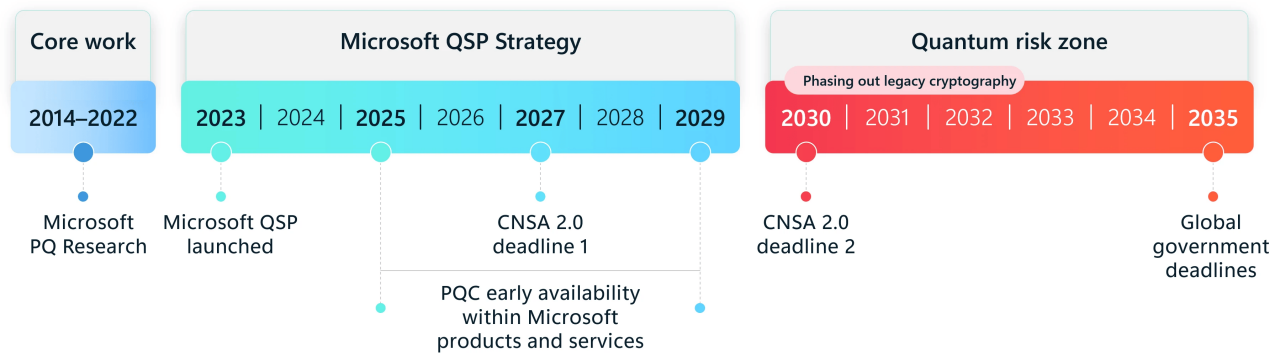
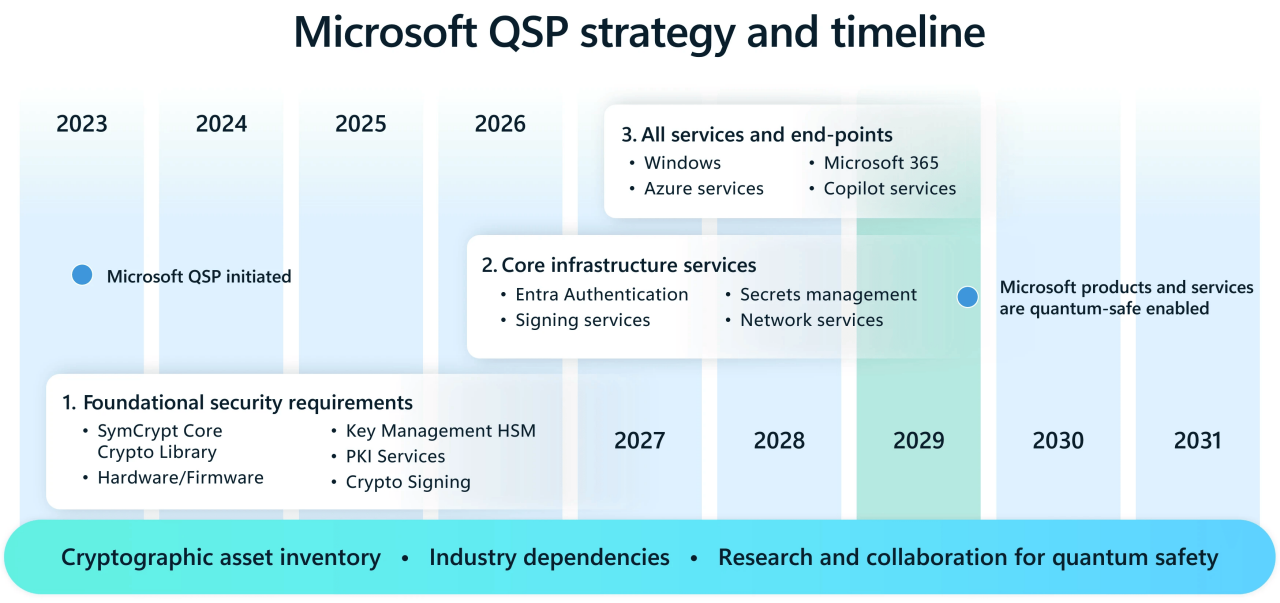
To maintain resilience of Microsoft’s services and systems against quantum computers powerful enough to break modern cryptographic algorithms, we’ve developed a phased transition strategy built on a modular framework. This approach considers each service unique requirements, performance constraints, and risk profile, resulting in either a direct shift to full PQC or a hybrid approach combining classical and quantum-resistant algorithms as an interim step. Therefore, as early adoption will begin by 2029, core services will reach maturity a few years before then.
Here are the three key phases for this strategy:
1. Foundational security components
Microsoft has integrated PQC algorithms into foundational components like SymCrypt, the primary cryptographic library that provides consistent cryptographic security across Windows, Microsoft Azure, Microsoft 365 and other platforms. SymCrypt supports both symmetric (for example, AES [Advanced Encryption Standard]) and asymmetric algorithms (for example, RSA [Rivest–Shamir–Adleman], ECDSA [Elliptic Curve Digital Signature Algorithm]), providing essential cryptographic operations such as encryption, decryption, signing, verification, hashing, and key exchange. Most recently we’ve made ML-KEM (Module-Lattice Key Encapsulation Mechanism) and ML-DSA (Module-Lattice Digital Signature Algorithm) available through Cryptography API: Next Generation (CNG) and Certificate and Cryptographic messaging functions. These capabilities are available to Windows Insiders and Linux customers now, with additional foundational capabilities coming through the next five years, always aligning and timebound to evolving industry standards and advancements.
As quantum computing advances, the threat of Harvest Now, Decrypt Later (HNDL) cyberattacks become increasingly pressing—where threat actors record and store encrypted data today with the intention of decrypting it once quantum capabilities mature. To counter this risk, security protocol standards are prioritizing quantum-safe key exchange mechanisms. For instance, TLS 1.3 is being enhanced to support both hybrid and pure post-quantum key exchange methods, making it a robust adaptable foundation for integrating PQC algorithms. With version 1.9.0 of SymCrypt-OpenSSL, we’ve enabled TLS hybrid key exchange as per the latest IETF internet draft, providing an early opportunity to help prepare for HNDL threats. This capability will be coming to Windows TLS stack soon.
2. Core infrastructure services
Updating foundational components in products and services, considered core infrastructure service, to provide quantum safety for Microsoft and our customers from future quantum risks. Examples include Microsoft Entra authentication, key and secret management, and signing services. By prioritizing these services, Microsoft will protect the most sensitive and essential components first, providing a strong foundation for the broader transition.
3. All services and endpoints
Integrating PQC into Windows, Azure services, Microsoft 365, data platforms, AI services, and networking enables the broader ecosystem of Microsoft services to be quantum safe, providing comprehensive protection across all platforms and applications.
What’s next
In Starting your journey to become quantum safe we provided some practical recommendations and services for customers to start their quantum-safe journey. In future updates, we will continue to provide insights and guidance, grounded in practical experience as we take these critical steps on a most important journey.
Transitioning to a quantum-safe environment is a complex but essential process and we encourage our customers and partners to start developing their strategy now.
To learn more about Microsoft Security solutions, visit our website. Bookmark the Security blog to keep up with our expert coverage on security matters. Also, follow us on LinkedIn (Microsoft Security) and X (@MSFTSecurity) for the latest news and updates on cybersecurity.