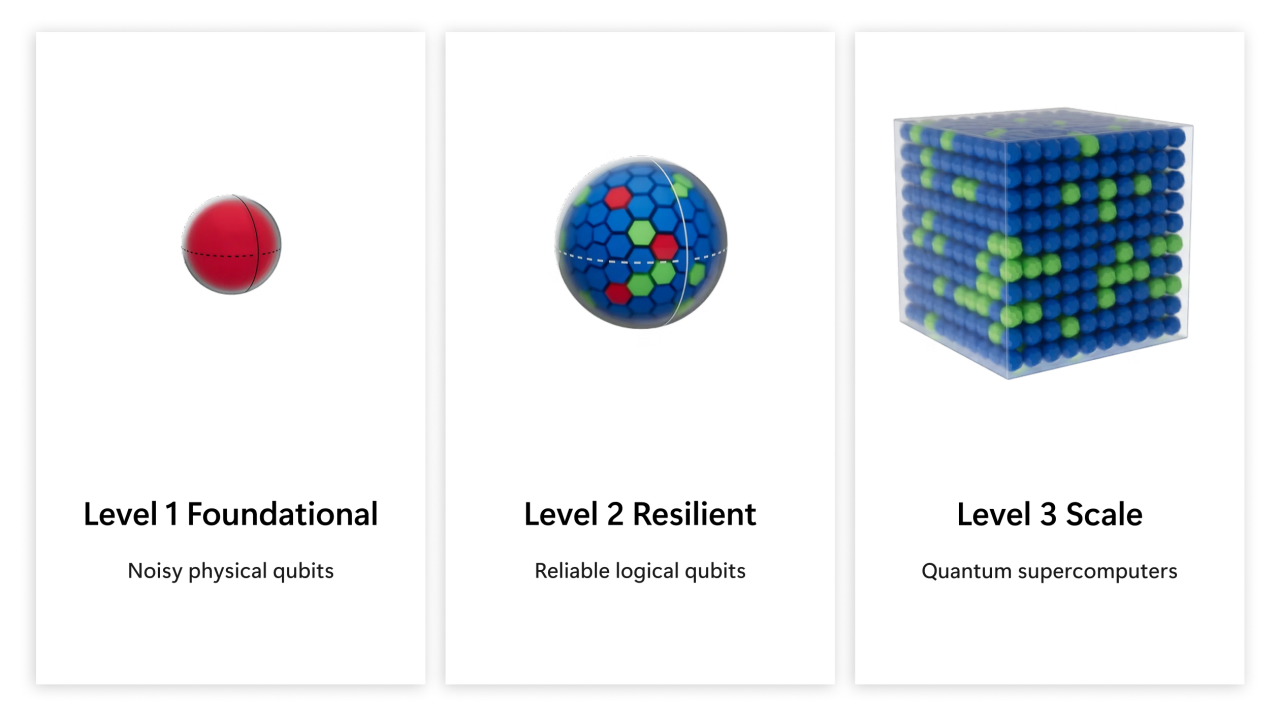
To make progress in quantum computing, we need definitions and clear metrics that evolve as we develop new goals.
 Quantum

By Dr. Chetan Nayak, Technical Fellow and Corporate Vice President of Quantum Hardware

To make progress in quantum computing, we need definitions and clear metrics that evolve as we develop new goals.
The right metric can tell you how far you’ve come from your starting point and how close you are to your goal. Without one, it’s hard to track progress: you might be moving steadily along your roadmap, but you might instead be executing a random walk.
At Microsoft, we’ve devoted considerable effort to finding the right metrics and using them to focus our attention and effort on the most important problems.
Different researchers mean different things when they use the term “logical qubit.” None of these meanings is “wrong” per se, but they aren’t all equally useful for gauging progress towards a utility-scale quantum computer. And it can be very confusing, even to experts within the field, when one person uses “logical qubit” to refer to any encoded qubit, while another might require it to outperform the physical qubits from which it’s built.
To make progress, Matthias Troyer, John Martinis, and I proposed a definition of a scalable logical qubit which entailed assessing a scalable logical qubit on four dimensions: reliability, scale, capability, and performance. This provides a framework that allows us to distinguish quantum developments as they happen.
Our starting point was that the goal is solving a hierarchy of valuable problems with a quantum computer, often called utility-scale quantum computation. This requires fault-tolerant operation that can scale with the problem size. Our definition separates technologies that clearly bring us closer to that goal in a well-defined way from one-off demonstrations that may not.
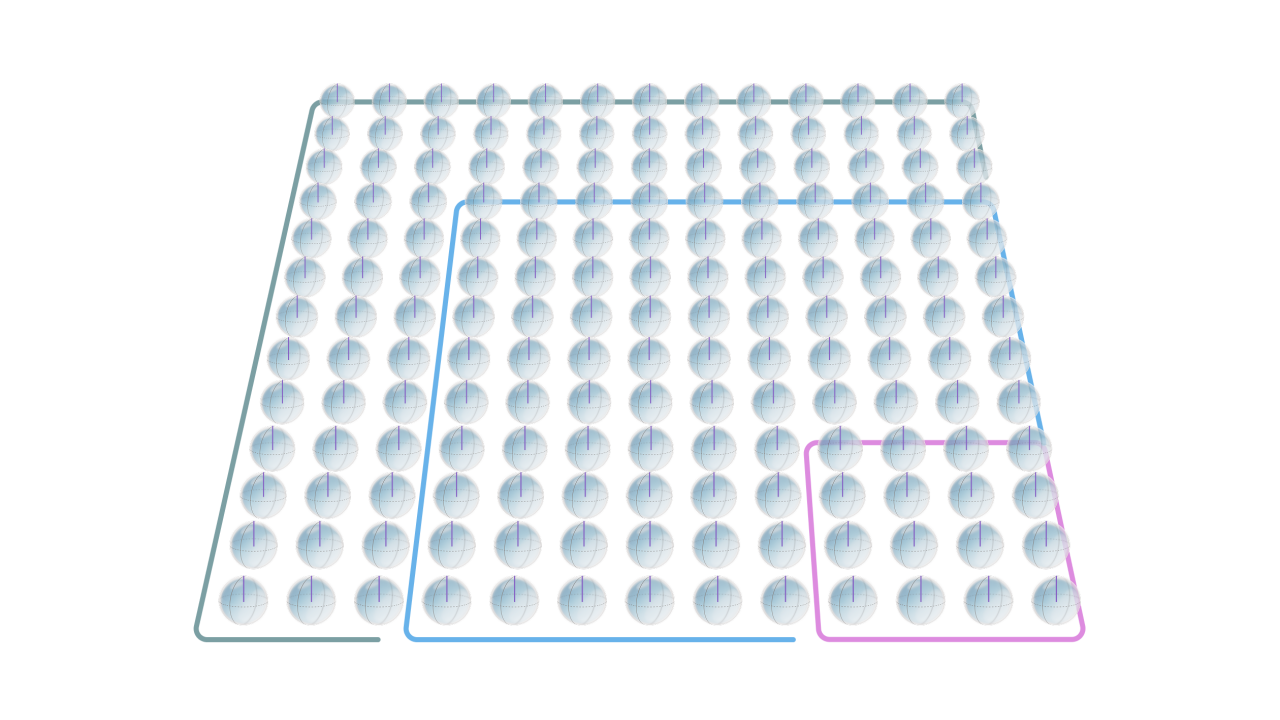
Defining a “topological qubit” is also surprisingly subtle. Topological order implies exponential scaling with temperature and length (analogous to the scaling of a logical qubit). But, in any given device, the length is fixed and a temperature range large enough to establish exponential scaling is usually not available.
We developed the Topological Gap Protocol (TGP) to identify topological superconductivity in nanowires precisely in the early stages when it is not yet extremely strong and to provide a metric, the topological gap, that tracks progress along the road to a stronger and more robust topological phase. The TGP is useful because it is very stringent yet readily performed.
In order to make devices that pass the TGP, we launched an extensive program of material and fabrication development. The topological gap, estimated by the TGP, is a key metric tracking the progress of this program, from our earliest topological superconducting wires (Phys. Rev. B 107, 245423 (2023)), to the improvements in our fabrication process that enable subsequent milestones, such as fermion parity readout (Nature 638, 651 (2025) and https://arxiv.org/pdf/2507.08795), to the major step-function improvement made in our new material stack (https://arxiv.org/pdf/2606.03884).
Of course, if we place too much emphasis on any single definition or measurement as a field, we risk the measurement or definition becoming the goal and losing sight of real progress. To avoid this, we must keep evolving our measuring sticks so that they remain meaningful. For the same reason, we need multiple benchmarks to avoid falling into the trap of over-optimizing for one benchmark.
It is salubrious when competing institutions and research groups work together to create and adopt robust measures and definitions and invite external entities to verify our results. Our new quantum research center, which provides a venue for independent testing and evaluation by the Defense Advanced Research Projects Agency (DARPA), is an exciting new development in our journey toward verifiable, scalable, functioning topological qubits.
We can think of Microsoft’s progress so far in the context of our roadmap: we have established the basic physics and a proof of concept: by increasing the topological gap, we have made our devices more stable. These advances have set us up for scaling to larger systems. One set of metrics guided us through the nascent phase of this technology, when the signals were faint, through its adolescent phase of steady incremental progress. As we move to more mature phases, transitioning from small topological qubit processors to larger logical qubit processors built on topological qubits, our metrics will continue to evolve.